Thursday, November 11

Yesterday's links

James Surowiecki (kottke's favorite economist) addresses privatization.
The ownership society promises freedom, but at the price of a huge shift in risk, away from government and society and onto individual citizens. Social Security, Medicare, insurance—these are basically collective risk-sharing mechanisms. Rather than let each person run the risk of ending up destitute or sick, these programs pool the risk. Because the risk is shared, it can be managed, and people can be guaranteed a minimally acceptable outcome.

That's what scares me: the individual risks. Could it be better to face the risks together, with lower potential returns, but also lower risk? Many people have already met with pension disaster. We'll be picking up the tab for at least some of that anyway.
But Social Security and Medicare are designed to protect people from things they have little control over—risk of illness, risk of macroeconomic change, risk of industrial obsolescence. To manage that kind of risk, you have to do it collectively. What’s more, as the political scientist Jacob Hacker has pointed out, Americans’ everyday lives are considerably riskier than they used to be. Jobs are less secure. Health-care costs are increasingly difficult to plan for. And the pace of technological change—which can lay waste to entire industries almost overnight—is faster than ever. So now may not be the best time to undermine the few programs that provide people with some protection against bad decisions and bad luck.

The ownership society’s greatest flaw, however, is that it won’t solve the problems it purports to address. A real solution would require facing up to some thorny issues—raising the retirement age, slowing the growth of benefits, means-testing. By advocating greater freedom and independence, while failing to explain or account for the greater risk, Bush is setting Americans up for an unpleasant surprise. If his plans are implemented, a lot of people are going to end up a lot poorer in their old age than they otherwise would have been. (A lot of people will end up a lot richer, too.)


Have you downloaded the first real Firefox release? Google and Bloglines have their own pages.

USC residence hall billed as world's largest "green" dormitory

I thought Douglas Rushkoff's 'Merchants of Cool' on Frontline was harrowing. He recently covered advertisers: The Persuaders. Not sure I can bring myself to read more, since I know it'll drive me crazy. I did read Matt's review and Paul's (which interprets through McLuhan).

Then, to close with something more cheerful, Matthew's head got attacked like the Death Star. Fortunately, the shot that went in didn't start a chain reaction.

Wednesday, November 10

audiopost: Maroon 5 and Vertical Horizon

this is an audio post - click to play

Barnett in Raeson

Tom posted an interview in a Danish magazine. The intro:
 “The tumult created by globalization’s creeping in on the Middle East was going to create anger and violence and terrorism. When 9/11 comes along, and the connections are clear to us – at least for an instant – the United States (frankly, nobody else has the firepower to do it) decides it has got to change the Middle East in a big, big way, looks around and says: “who can I start with?” It decides on Iraq, and I say “that’s as good as anybody”. So are we going to kick his ass militarily in the war? Yes, absolutely: supreme confidence there. Are we going to screw up the occupation? Absolutely! Why would you advocate going even if that is going to happen? Because this military is not going to change unless it experiences failure on that far side.”
He gets pretty quickly into his vision of the role of the New Core, including Russia, India, and China. I've been pushing Macon on this, and he's pushing me back, so maybe this will provide some content (and then I'll go on to other content. And my formatting will be a little funky because I'm copying from pdf and I'm not going to reformat the whle thing.).
You cannot bring Russia sort of into NATO
without changing NATO, and not as a result
make that a different Rule Set. Look at China
buying up our US Treasury Bonds and becoming
the biggest source of the US trade deficit; or India
supplying all the IT-workers and doctors to the
United States plus remitting such sums of money
back to India in terms of non-residential Indians
who work and live in the United States. That kind
of integration processes cannot help but create
new Rule Sets. They always tend to come in the
economic realm first.

So there are a
lot of things that we are going to learn and adjust
to as, for example, India becomes a much bigger
part of not just the U.S.'s but the whole world’s
economy. To understand what it is to have Russia
actively involved in world affairs, when for
several decades it was always on the other side of
the fence. To have China develop this
tremendous integration with the outside world.

it seems like such a jumping-the-gun phenomenon
for us to always be looking for slippage, always
be putting the worst sort of perspective on the
motivations behind anything that Russia, India or
China do as they deal with some significant
changes. They have in recent years changed from
economic policies that were very state-heavy for
many decades and moved towards the embrace of
markets in a very profound way. You would think
we would be happier but it is almost like we look
for every opportunity to say: “you are not going
fast enough and far enough, and – aha! – that
means you, secretly, deep down, inside, must be a
threat”!

We have wished for this to happen for so many
years and when it does happen we cannot believe
it: we have such great suspicion towards these
three big countries. I think about them a lot
because they hold such a big chunk of the world’s
population and if you can remove that kind fear
factor within the Core a lot of things will work
out pretty dramatically.

But India and China do not feel like they have
been invited into the corridors of power. They are
part of G20, but they are not part of G8. They
kind of wonder how the G8 gets to figure out
what happens in Iraq. The G8 had this meeting in
Sea Island [G8 Summit, June 8-10, 2004] and
there decided what they were going to do about
the future of the Middle East – and there was no
China there.

If you do not want it to be a West versus Islam
thing, then do not alienate the biggest players in
the East. Either they live closer to the problem,
like Russia; or they see themselves as natural
regional powers, like India; or they are going to
have their energy requirements from the Persian
Gulf doubling over the next 20 years like China.
Compared to their interdependencies with that
region, ours and even the Europeans’ are small.
I really agree with this picture of the Palestine/Israel situation:
That is the lawyer with three kids who straps a
belt on with dynamite in the West Bank because
that looks like the best option for him after going
to law school: that is the best future he can come
up with. But if you can give him a job a law firm
somewhere I guarantee you, he does not get on that bus.
Back to the Big 3:
The trajectory that Russia has been on
for the last 15 years; China for the last 25; and
India just for the last 10 is just stunning. Because
their societies are exposed to these strong,
external influences this is the perfect time to
shower them with security.
Tom's analysis of the UN:
The problem was that the UN was not the vessel
for that: it is such a Congress-like entity, a
legislative branch, without a real executive
function. The best you have is a group that can
cite bad activity around the world, but does not
have any means to deal with it. The hope is, if the
UN condemns somebody that they change their
ways and somehow get beyond the violence and
then we can send the peacekeepers in.
On multilateralism in Iraq:
We said in effect: “If you’re not tough enough to show up
for the war, don’t show up for the peace: don’t
expect to be cut in on anything!” That was a
huge, colossal blunder on our part, a very macho
view of security as if the only thing that matters
is the “blowing up” part. We have learned since
the occupation in May 2003 that our people get
killed just as quickly in the peace keeping as in
the war part. Actually, more quickly because we
do it so badly.
More on the UN:
And what can the UN do? They can
indict you. It is actually a grand jury, even the
UN Security Council: they cannot actually issue
any warrants for your arrest. They can say: “you
should stop, and if you do not stop, we will not
let you sell sugar for the next ten years”, and slap
some really meaningless economic sanction on
you – which historically has almost never done
anything of value, unless it was universal like
with South Africa under Apartheid.

This where the G20 comes in: the G20
is the star chamber of everyone who matters in
the global economy. When you take the 20
biggest economies, you really get the whole
package, about 90% of the wealth. The G20 is
where you will find all the money and the
authority, where you can locate the entirety of the
Core. If just that body could evolve over time, as
you see it struggling with ever since 9/11, where
security issues have been dominating the G8
meetings. The Sea Island meeting was an Iraq
meeting! They barely talked about the global
economy. They are already aspiring to that role
without saying it. If you made that G20 a package
that could have an executive function, where it
could say: “the UN has said these guys are bad,
we all agree that they are: could we come to some
understanding that the Leviathan [the US military] should be
used?”

Then you could have the Leviathan be put into
service with the knowledge that a System
Administration force on the far side – where the
US has a much smaller role, and the allies around
the world a much larger – will come in once the
take-down (or “the correction” or “the security
element”) has been dealt with. If you employ the
Leviathan force inside the Gap in this manner,
then there would be an upfront agreement that the
SysAdmin force will come in the Leviathan
force’s wake. That force, a very manpower
intensive function, takes the occupation through
its phases effectively.

Then you have another gap being filled on the far
side of that: an international organization like the
IMF but one that specializes in exactly what we
are talking about – that weird mix of security and
development. This is what Sebastian Mallaby of
the Washington Post calls the IRF – the
International Reconstruction Fund – like a
perpetual Marshall Plan for politically bankrupt
states designated for rehab. Who would fund that
IRF? The same G20 that would make the
decision upstream in the process. They would
vote according to how much money they would
put into it. And then you have the International
Criminal Court on the far end. It is that kind of A
to Z function: then you would have a real system.
On the role of Iraq in the war on terrorism:
Either you fix the system as a
whole – or you accept that you will have to shoot
at anything that moves in certain parts of the
world for the next 50 years, and I find that
morally bankrupt. That would be condemning a
big chunk of humanity to a horrible existence.
But is it harder to go in and make that change
happening? Absolutely.

Globalization is coming to the Middle
East, and we have to integrate it. That energy has
to come out of there, because developing Asia
needs it, and we need developing Asia. If we do
not go there security-wise, the Russians and the
Chinese and the Indians would be coming, and
eventually the Japanese too. We can get there
first, and try to make it a good thing, make it
cooperative and a benefit to the region as a
whole. Or we can wait until it gets really bad, and
poor China gets so desperate that it starts doing
something crazy or scary or intimidating. And we
would go: “Hey, you shouldn’t be doing that”,
and then we would have ourselves a nice cold
war brewing in the Core again.

The Europeans are the
leaders in rule making; the Americans are the
leaders in profound new technology and the
ability to wage war; the Chinese have this
amazing new power in making [manufacturing]
everything; the Indians have this bizarrely tilted
power in Information Technology; and the
Japanese are sort of this new center of cool and
design and fashion.

If you make a
logical argument about the exertion of security,
then people will say: “Who will die for your war?
You must be doing this for empire; you must be
doing this so multinational corporations can go
around the world and exploit labor!”

And I say: “Your point? Yes, I am: it is called
development! Talk to somebody who has no
multinational corporations exploiting their cheap
labor: it sucks, it’s called Central Africa!” But
show me a place where they do have them do it,
and yes the first generation’s life looks like
England in the 1890s: they work in factories and
the conditions are rotten. But their kids go to
school and become something better, and then
their kids' kids become something even better.
That is how we did it. How do we expect
everyone else to magically jump ahead?

in many ways, we are moving away from paradigms
of war to paradigms of police work. Across the
Core we do have cops, and it is robust system. In
the Gap there are no cops: you can kill 100.000
people before anyone cares. Hack them up with
machetes, and throw their bodies down the river,
and maybe five months later the UN will say:
“that’s really bad, you should stop!” So we are
talking about extending police work.
On the Bush Administration:
That is why I, as a
Democrat, actually find myself supporting Bush
more than Kerry, because he speaks in terms of
right and wrong, good versus evil. You need a
certain amount of that to get people up to do it,
because these are not easy things. You need Putin
to be Putin sometimes. If you say: “Well, why
don’t you negotiate with them?”, then he will say:
“They just killed 300 of my kids! Why don’t you
go negotiate with Osama bin Laden?!” At some
point you have to say: “That doesn’t work!”

This administration is doing much
of what I argue for, but I do not claim that they
are following my logic – I claim it to be the logic
of the world. They are employing almost a
Nixonian sort of secrecy on it, as though the
world would not trust them on it. In that secrecy,
which is almost pathological, many people are
rushing in to fill the gap – with conspiracies,
charges, accusations and labels.

Americans are somewhat schizophrenic on this, since we accept
30,000 deaths a year with gun violence – but bin
Laden can go commit 3,000 murders on
television one day, and we will be so mad about
that that we will go invade countries.

But thank God we still react violently to
terrorism: that it still lights a fire under us, and it
is finally lighting one under Putin. We can either
deal with it or we can choose not to, but it is not
going away, and this globalization process will
not stop just because we stop supporting the
Israelis or get off oil or something like that. The
older I get the more convinced I get that life is
accomplished by those rushing to embrace the
bad things, because you may as well get it over as
soon as possible. I learned that when my daughter
got cancer at age two, which I write about in the
book. It really taught me something about
strategic planning: dealing with difficult things in
the right fashion, not dragging them out.

Paul on presidents

I really liked Paul's comment (from this thread):
At least since 1992 in every Presidential election I have held my nose and voted. This one was no exception. Mary mentioned some time ago that it would be refreshing to hear President Bush or someone else in the administration say something like, "We made a mistake on that one; we learned from that mistake; it won't happen again; but, yes, we made a mistake". Or say to the Christian right, "We will try to keep the playing field level for you and any other religion whose purpose is not to subvert the US government. On the other hand, don't ask us to tend to your business. As to homosexuality, come back and talk to us when you get the divorce rate down in your churches to something significantly less than the general population."

Barnett to Congress

Tom Barnett briefed the Overseas Basing Commission of Congress yesterday. Here's his opening statement. I'm glad they're asking for his input. I'm a little hopeful that we'll get our basing right.

Not sure why Tom found it necessary to give them all of his jargon.

Saturday, November 6

Macon's reasons

How did I miss Macon's reasons for voting for President Bush? My comments:

War: not eye-to-eye, but I generally agree. I still can't believe how anti-nationbuilding Bush was in his first campaign, and now...

Supreme Court: yes. Strict Constructionism is best.

Culture of Life: the classic liberal tweak here is: what about war and the death penalty? Not saying I buy that, but do you care to address it?

Economy: I think President's have a bigger impact than you think they do. I think they're leadership in tax policy and in spending (eg, budgets, deficits, debt) is huge.

Unilateralism: you keep saying this means France, Germany, and Russia and I keep saying no it doesn't (of course, I may not be who you're dismissing when you write 'the critics' ;-). Maybe it does for everyone else, but not for me. A more diplomatic run-up may have led to a more multi-lateral rebuilding, which would have been a major advantage. France and Russia were on the take. Who cares about France anyway? But Russia's more important in that region, and a potentially emerging ally. Why alienate people we don't have to. As I've said before, what I really would like is Chinese, Indian, and Russian peacekeepers. Then it's an Asian deal instead of a Western deal (public perception wise). The UN isn't much good. The Security Council is particularly oudated.

WMDs: Kerry thought they had them because the Bush Administration's intel told us they did. I don't think this was a case of lying, but a case of ultimately interpreting scanty evidence to a desired outcome.

Quagmire: It's hard, true. But 'Deal with it' is too curt for those who didn't support the war in the first place or who feel we were mis-led there or who fear the ghosts of Vietnam (and Afghanistan). And committing to indefinite unilateral rebuilding is a really tricky thing. Bush gets four more years to work on it.

General links

kottke liked 'The Incredibles'. We hope it's ok for kids. Wil would love to see it. He's been playing Dash a lot just from surfing the website.

10x10: an interesting Flash of the news.

Love this kottke quote from David Brooks:
If you want to understand why Democrats keep losing elections, just listen to some coastal and university town liberals talk about how conformist and intolerant people in Red America are. It makes you wonder: why is it that people who are completely closed-minded talk endlessly about how open-minded they are?

Philosophical break-up lines (via BoingBoing). And, therefrom, Causes of deaths of philosophers eg: Augustine: Hippo. What's your favorite?

And three from AskMeFi and then I'm really done:
Who are the Most Overrated Stars in ShowBiz?
A good counseling advice thread (some nice things going on in here)
Best MeFi thread for conservatives EVER: Why did you vote for Bush?

The Decline of Brands

I really liked The Decline of Brands by James Surowiecki when I read it in Wired. Now it's getting some linkage around the web, including kottke and this post by Cory Doctorow (who links back to kottke in the a-list pyramid scheme ;-).

More election stuff

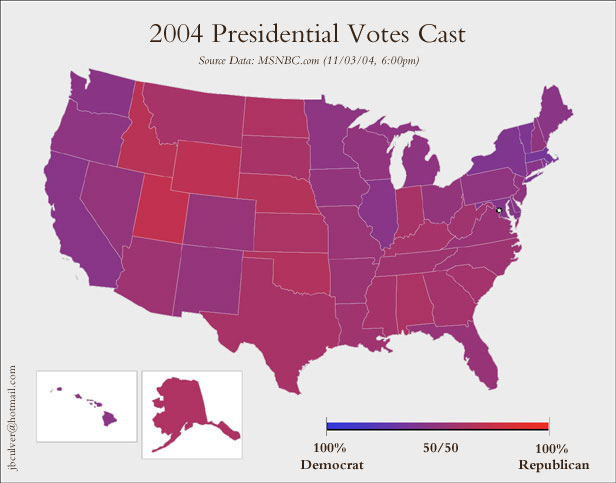
More red-blue-purple maps, this time adjusted for size of county. (via kottke)

Another (joking?) proposal to split the US into Red and Blue nations (I saw - and linked - it first from Eric (at the bottom)). To remind you, here's a map of how they turned out. If it came down to a vote like this, I wonder how the states would vote... I wonder where I would choose to live. Of course, you can argue that we're already like this a little, if we're a federal republic of states. I think Barnett would argue that, to some degree.

And Brad posts the United States of Canada (I hadn't seen it yet):


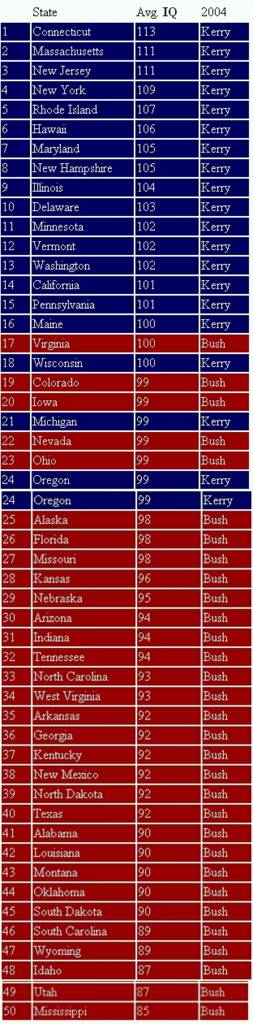
Here's a purported correlation of state IQs and votes. Guess what it looks like? He's worried about bandwidth, so I'll post it as well:


You'll think I'm crazy, but part of what I take from this is IQ isn't everything. Maybe that's another way to think about the divide in this country:

Red: values over intellect
Blue: intellect over values

Want to help me sharpen this up? Interact!

More: Jeez, will this thread never end (not sure what it's doing to your feed-readers. I don't read my own feed)? Anyway, Jaq links an article that says it was security and not values. Maybe.

Barnett

Big post with lots of riffs.
Then again, hard scientists (surprisingly enough) are often better than soft ones (like political scientists) in horizontal vision. I know that sounds counterintuitive, but it's true. There's actually far more pinheads in my field than, say, chemistry.
I wonder if this has anything to do with postmodernism. I see a lot of scientists who are more modernist in their thinking, and this lends itself to certain strengths.
In short, horizontal thinkers like myself tend to be late bloomers, because it takes so much longer for everything to come into focus.
May this be true of me.
I've long believed that having Iran on the "rogue" side of the ledger will continue to deny us the stabilizing outcome we seek for the region as a whole (and if no one's gonna say it, then I will: Die Yassir! Die!). I want that outcome, but I want a cemented strategic relationship with China as much or more over the next four years, because I'm convinced we need to lock in that embryonic security bond as well as similar bonds with both India and Russia, and I see a strategy for Bush over the next four years that points in this direction.
So it did all come down to the question of gay marriages!

Islam's moderate middle path is found in southeast Asia
What's interesting to me about the article is how basically all the examples of where the government has gone out of its way to favor Muslim Malays over other ethnic-religious groups has to do with the definitions of family, marriage, and sex. So you get the feeling that the moderation has to do more with economic and politics, whereas the "gives" to the majority Malays tend to register in the social values sphere.

Interesting no? Makes you think about this election? The conservative majority okays the Bush team on their economics and national security in return for their efforts on upholding social values. Looking on it that way, you get a sense of what it means to be more Core-like than Gap-like: you push the connectivity of free trade, free markets, collective security and transparency, but you do let yourself engage in some content control and some behavioral modification when it comes to the truly touchy stuff like family, marriage, and sex.

Friday, November 5

Yesterday, the links

Given that he lost, I'm glad Kerry conceded and that thiselection didn't go to court, as I feared. He seemed pretty classy. On the other hand, I saw President Bush on CNN yesterday being unneccessarily confrontational over a question of Supreme Court nominations. More conciliatory, please...

The election maps you've likely already seen: degrees of purple by state and blue, purple, and red by county.

kottke on the election and how 'we're all stupid' (except Karl Rove). I agree with a lot of this (though not the 'learn science from the Bible' crack).

Eric's got some thoughful reflections on the election.

Barnett on the election: 'shared social values trumped mistakes in the steering of the global war on terror', 'people on the coasts are often people on the fringes of everything I readily hold dear, and their arrogance about the "little minds" living in the middle is just too galling for words'.

Follow-up to yesterday's post: Moral Values Propel Bush to Re-Election

From cells to bells, 10 things the Chinese do far better than we do. The we in this article is technically Canada, but it still applies. I've got my eye on China's economy more as I've been reading Barnett.

Matt's got a post on the new prefabricated homes. In the article they focus on the Glidehouse (too-much-Flash warning). Pretty swanky.

One group estimates that BitTorrents account for 35% of Internet traffic. Whoa. My first torrent was the Jon Stewart Crossfire.

Thursday, November 4

Election aftermath

I'm somewhat liberal when it comes to social policy. I'm conservative on religion and morality. A lot of the weblogs I read regularly are much to the left of me. Here's the thing: we're not making any progress in this country while we continue this culture war. As long as we think everybody on the other side is crazy or stupid, we won't make any progress. We need to expand civil discourse, the issues covered thereby and the number of people involved therein.

You can make a good case that the biggest divide in this country is between religionists and secularists (and I hope those are fair terms). As long as the religionists view certain voting issues as moral issues (eg, abortion and gay marriage), they'll have a massive advantage in getting out the vote. They voted down every gay marriage referendum in this election, and voted for Bush while they were at it.

Obviously, another big factor was the security vote, which went to Bush in the common thinking. But I don't think it was as much of a factor as the secular/religious dichotomy.

I don't think this divide is good or bad (ie, the religious and secular camps). I do think there's lots of stupidity involved. There must be since the negative campaigning and Michael Moores/Ann Coulters of the world have an audience. But writing our opponents off as dumb, or demonizing them, can only hurt all of us.

Greg Knauss has a guest essay saying some of the same things. My answer (expanding rational, civil discourse) is different from most of those in the ensuing comments over there.

You know, if you read here regularly, that this post does not mean I'm crazy about the reelection. But it's not the end of the world, either.

One more time: more rational civil discourse.

Tuesday, November 2

Barnett Today

Judging the Global War on Terrorism.
Synopsis: It's been successful because there haven't been any attacks in America since 9/11. We've made this into an away game contested by our professionals instead of a home game with casualties to our home crowd (to torture the metaphor). The Department of Homeland Security is 'vast overkill' and we haven't done very well at the nation-building part. Our civil liberties have been cut back, but not aggregiously so.

I agree with most everything he's saying, as least to some degree. He's pushing me on the War in Iraq. I do think the DHS is an overreaction and that the money could be better spent (with some similar jobs by pre-existing agencies, of course).

Everybody take a deep breath and relax on election day. Some historical reflection from George Will on similar situations and a positive view of early voting. An interesting quote:
At the dinner I attended last night to discuss PNM, a lot of angst was raised about the red state/blue state polarization of American politics. My answer was that this was not that unusual if you look back over the length of American political history. Plus, when you look at what we are so jacked up about concerning the Supreme Court, that cluster of issues is awfully narrow and removed from much of daily life (the nexus of abortion, stem cells, etc.). This is not so much a hugely divided electorate but one that squabbles incessantly over relatively small issues (historically speaking) on the margin.
Barnett's an economic determinist, so he views these divisive issues as marginal. I accept that from an ecnomic and security standpoint, but I feel I

9/11's most pervasive new rule set is classified.
On a superficial level, the hush-hush treatment of this issue on the fall campaign trail might seem perversely fitting. But Mr. Bush's unilateral rollback of laws and practices designed to promote government accountability surely rates further scrutiny by voters. We've learned over the last four years that what we don't know can hurt us.
New Core economies: where is the action is....
Isn't it amazing—as well as counter-intuitive—to remember back to the time when our policy towards the old Soviet bloc was: "For God's sake, don't let them get their hands on information technology!" When—in the end—that was the very thing (that Information Revolution) that served as the downfall of the socialist, centrally-planned economic system?

Sunday, October 31

audiopost: Maroon 5/Sting

this is an audio post - click to play

Morning loggage

Barnett writes that the Europeans will be unhappy no matter who wins the election (about halfway down). No surprise. They don't want more Bush unilateralism (as we've seen in the links that the world wants Kerry to win), but if Kerry comes in they might actually have to put up for Iraq reconstruction, including peacekeepers. He's also got and interesting list from 'Die Zeit' ('The Times' in German, for those keeping score at home) of things we'd have to do to build a coaltion for reconstruction. They look doable to me, and even desirable.

Clearview: A New Typeface for US Highways. Interesting (to me) re: typography AND highways.

Thursday, October 28

Barnett again

Well, Barnett doesn't have anything of note today, so I'll have to make up my own. Notes from his talk on C-SPAN:
  • He worked on the worst case scenario for Y2K. Looked surprisingly like 9.12.01 and the Asian flu.
  • Wall Street intelligence is very impressive.
  • He looks at the military economically and as a business (sometimes). So he often analyzes military action in terms of 'billable hours'. This is personnel focused, and useful in many ways.
  • China and Japan haven't done much for the war in Iraq. But they finance out 2 or 3/5ths of our debt, and they have keen interest in Middle Eastern oil.
  • Go after the terrorist's strategic goals. Bin Laden wants the US out of the Middle East so he take the ME out of the world (i.e., disconnect it). Now we're in the ME in a big way. Most attacks have been in the ME since the invasion.
  • We can fight a war without reserves, but we can't win a peace.
  • His guess on Israel-Palestine: US peacekeepers on a wall to keep them apart, like Berlin and Korea.
  • We have been closing bases in developed countries (his Core, basically) and opening bases closer to the developing world (his Gap, basically). The Gap is the expeditionary theater for the 21st century.
  • Good News: our military is great at fighting wars and where they should be.
  • Bad News: our intel stinks and we're really bad at nation buidling. Rumsfeld is a good Secretary of War, but bad at everything else. Further, our military forces are designed to fight and win, not occupy and build.
  • B. says 'you show me a country that develops to >3000$/yr income and I'll show you a country that gets out of the violence business.
  • The average income in Saudi Arabia is going down. 'I guarantee mass violence.'
  • China is changing a lot. After SARS the WHO said 'straighten up or we'll stop travel there immediately'. And the WTO made them open to private investment.
  • The Bush Administration planned for the next big war (v. China) and wanted out of the nation-building business. They try to stick military unpreparedness on the Clinton Administration, but the demand by tax-payers for a 'peace dividend' began in GHB's administration, and GWB's administration made their own mistakes.
  • A big part of B's schtick is arguing for a 'Sys Admin' force that can occupy and stabilize and build and conduct civilian affairs.
  • B. assumes a hydrogen transportation solution in 20 years.

Wednesday, October 27

Google today (and OneLook)

OneLook is my new favorite crossword puzzle aid. It allows wildcards and even a crossword puzzle mode (which I have switched on). It's even got a reverse dictionary in beta. I've been wondering for some time why Google doesn't allow wildcards (though I did learn some handy tricks off of the Google Cheat Sheet today like ~ and *).

Can Google Answers teach me to whistle? I tried it for a little while, but not really in earnest yet.

Google bought Keyhole so its users can search the surface of the earth...literally. It's only a matter of time before the Googlebot has the location of my Superman shirt in its cache.

Barnett today

Says we should buy fewer F/A 22 Raptors at 258 Million $ per. Boy howdy.

We need multinational troops on the ground there and that's why you should vote for Kerry.

Bush's conservatism is really radical, so vote Kerry.

The price of oil is not that high (amazingly not a reason to vote for Kerry! ;-).

Tuesday, October 26

KidFilter

This is what happens when we teach our children to think and express themselves, to be in touch with their emotions, and when we give them stories:

Eric has a nice story about his son.

BarnettFilter

Since Barnett's voting for Kerry, I thought I'd explore that a little by searching 'Kerry vote' on his website. Some of what I found that interested me:

Barnett predicts that America will add up to a dozen new states, starting in Latin America by 2050. Wow. Off the top of my head, I could see this, if the US was a looser confederation, with stronger states' rights. It's hard for me to imagine adding to the current federal behemoth.

Bush and Kerry are pretty even in what they're saying about the war in Iraq. Specifically what we could do to make reconstruction more multi-national.

The real problem with Bush's 'Cut taxes and spend' approach.

Monday, October 25

The Pentagon's New Map

I can't believe I haven't come across Tom Barnett's ideas before. They're huge, encompassing war, economics, and globalism. In addition, he's audacious enough to think he's got the world figured out and to formulate a plan to best address the issues. kottke's link of Zuckermann's notes of Barnett's talk at Pop! Tech got me started. I love big ideas. And maybe this is the one I've been looking for. I Bloglined his weblog immediately. Heck, we've already traded email. Chances are you'll be seeing me link to him in the days to come. But where to start for you?

For a little taste, here's a post of his on oil prices.

So he's got a book out called 'The Pentagon's New Map'. I requested it from the library. He has me seriously rethinking my opinion that Iraq was the wrong war. Not that I think the Bush Administration is working out The New Map. But I think the global benefits may be worth having singled out this regime (somewhat arbitrarily). After all, as Barnett notes, most of the attacks have reverted to the Middle East after 9/11/2001 and the Iraq War.

If you really want to start getting into Barnett, you should probably start with the Esquire article that came out the month the war in Iraq began.
Show me where globalization is thick with network connectivity, financial transactions, liberal media flows, and collective security, and I will show you regions featuring stable governments, rising standards of living, and more deaths by suicide than murder.
He is not your standard neo-Con. In fact, he's voting Kerry.
Think about it: Bin Laden and Al Qaeda are pure products of the Gap—in effect, its most violent feedback to the Core. They tell us how we are doing in exporting security to these lawless areas (not very well)
I especially like his strategy of 'Shrinking the Gap'. Barnett calls himself an 'economic determinist'. He wants to globalize these underdeveloped countries so they'll stop killing people. It's be nice if the EU would take on the Balkans (since it's right in their backyard. Heck, their frontyard...). Hopefully China and Japan (who is providing economic mentoring to the former) can vector North Korea into sanity.

But he doesn't want Foreign Aid to do it. He wants Direct Foreign Investment. Central Africa is his paradigm for disconnected futility and I don't disagree.

He calls Israel 'the toughest bully on the block'.

You might say his view is very Ameri-centric. It may be. But he is an American after all (and so am I).

Friday, October 22

Fellowship 9/11

Michael Moore's searing examination of the Aragorn administration's actions in the
wake of the tragic events at Helms Deep.

I don't plan on watching it, but the webpage made me laugh. (via MeFi)

Wishlist

The function I most want is a del.icio.us add-on for Blogger.

I'd also like an app that helps me keep track of comment threads I'm involved in. Does this already exist? Anyone have a recommendation for how to best handle this? I don't trust my memory! Something within my regular web apps (Gmail, Blogger, Bloglines, and del.icio.us) would be preferred. Maybe I should post this to Ask MeFi...

A pony (not really ;-).

An iPod.

It's Creation!

John and I are discussing creation-evolution.

Thursday, October 21

Today's links

Go Sox!

My Little Justice League (via MeFi)

Matthew tells a few jokes (and gets a few).

I lust for satellite radio (but not as much as for an iPod).

My presidential platform

I started with this thread in MetaFilter. I took this survey and drifted between 45 and 67% Kerry. Then I took this survey and got 63% Kerry (and only 25% Bush).

Part of the vibe of the first test, I think, is that personality (and character) don't matter as much as the issues. I disagree. They matter. But I'm not sure how that affects my decision. That is to say, I'm not sure what I think of these guy's personalities and character. I sure don't like their campaigns.

I started my own presidential platform a while ago from the candidates' platforms (I looked at Nader's, too). Now I've rounded it out with some grist from these two surveys, so here it is, in all it's glory:

My presidential platform:

1.Responsible dealing with Iraq. Cultivate international cooperation, though the UN is very broken. Engage the UN, but expand NATO's role.
2.Fund independence of oil, especially Hydrogen Economy. Move toward paying the real price of gas at the pump. Consider Bio-diesel and ethanol. Phase out gasoline subsidies, leading to a greater market for fuel-efficiency.
3.Improve civil liberties – evaluate Patriot Act.
4.Fair Trade: Promote free trade. Factor-in environmental and human rights/labor. Help transition workers from dwindling industries (instead of propping up). This includes cutting farm subsidies to corporations and transitioning American farming toward market soundness.
5.Repeal the tax-cut for those who make >100,000$/yr
6.Balance the budget; cut government spending; reduce the deficit with repealed tax-cuts.
7.Reform taxes. Simplify radically.
8.Fund world AIDS relief
9.Universal health care: Medical savings for those who can afford it. Coverage for those who can't. Limit malpractice suits.
10.Fight terrorism by cultivating foreign good will. Not door mat, but fair.
11.Education: raise teachers' pay, create better teaching environments, more local decisions. Focus on traditional school time rather than HeadStart or after-school.
12.Environment: conserve public lands and National Parks, stop pollution and improve water quality. Mandatory Clean Air Emissions Standards
13.Gun control: background checks, required training and licensing, ban on assault weapons
14.Immigration is good for America. Encourage at reasonable levels.
15.Social Security: Work at SS solvency. Cap payments to wealthy.


Obviously, this could be shot apart. Please be a little courteous and constructive in your comments. But feel free to disagree amiably.

Wednesday, October 20

links from today

Jaq and Jess and I are having a fight about the Patriot's luck (check the comments, too).

Matthew's got a pretty interesting post about reading a book about corpses.

If you missed Neal Stephenson's interview at Slashdot, don't.

This pre-Halo 2 intrigue is crazy. I Love Bees. The weblog (I LOVE that they used a free service for this part!).

Let the Hobbit happen.

Tuesday, October 19

Carlson strikes back

Tucker tries to get his digs in after Stewart rode him on his own show. Stewart's not commenting, which seems like the better way to go. Carlson said:
"You're selling out," he said. "If you are a satirist or an acute social observer, and he is, and all of a sudden you suspend disbelief on someone or suck up rather than prod or poke someone, people will look at you and say, 'Even if I agree with you, I don't like it,'" he said.
Carlson's assertion is ironic. Stewart was arguing that Carlson was a sell-out because he's pretending to be offering useful debate, but just serves up partisan rhetoric that is unhelpful, which I, of course, agree with. On the other hand, Stewart's doing comedy.

Stewart's getting all the style points on this one. Carlson just looks cranky.

The Lambeth Commission

Brad posts an article that summarizes The Anglican Communion's decisions about the future of their church.

As a conservative, this report is mixed, to me. I line up with the Anglican conservatives who say there should be real repentance and who viewed themselves as justified in taking dissenting Episcopalian congregations under their wing. So, for the report to just ask for an apology AND to say the conservatives were out of line in their oversight, that's not optimal in my view.

Still, the Episcopalian Church USA is not apologizing for thier action, but expressing regret that it made people feel bad. (Sheesh. I'll give them this. They're playing it exactly right and have the whole time: not saying (usually) that conservatives are dead wrong but that they're 'different - not that there's anything wrong with that- and can't we just get along?)

Will the Anglican Communion stand up to them, or let this one go? This first report looks pretty wishy-washy...

The Mysteries of Catalhoyuk

Nice Neolithic link via thatwhichfalls at MeFi.