Saturday, January 21

Adaptation of Psalm 150

As you might know, I practice observing a psalm of the day (https://seanmeade.blogspot.com/.../practicing-psalm-of...). Recently, that psalm was 150, which is great, but a little outdated. So I decided to adapt it with more modern instruments and people I know.

Psalm 150


1 Praise the Lord!

Praise God in his sanctuary;

    praise him in his mighty heavens!

2 Praise him for his mighty deeds;

    praise him according to his excellent greatness!


3 Don praises Him with the trombone;

    Lots of us praise Him with the guitar!

4 Elizabeth praises Him with dance;

    Jennifer and Martha praise Him with the flute!

5 Stephanie praises Him with sounding cymbals;

    She praises Him with loud clashing cymbals!

6 Let everything that has breath praise the Lord!

Praise the Lord!


Link to post on Facebook with people tagged


Sunday, January 15

Funeral Message 2023


This is a message intended to be read at my funeral: Funeral Message 2023.

If you're interested for some reason, I wrote a version of this around 2001: First Funeral Address

Tuesday, January 10

First Funeral Address

I first wrote this around 2001. I recently wrote an updated version, but I'm putting this one here for the record.

First Funeral Address 


Saturday, June 18

Reviews of Bonhoeffer's 'Letters and Papers from Prison'

I read this a while ago in an early, simple edition that didn't give enough context. So I recently re-read it in an expanded edition that was a lot more helpful. Here are my second and first reviews from Goodreads in that order

Overall, this is a great book well worth reading. I haven't put my finger on it yet, but I think Bonhoeffer has some powerful lessons for us about nationalism in this time.

Unintegrated thoughts from my second reading:

Reading this book is a long exercise in observing hope that will never be realized in this world. Bonhoeffer hoped to be released, in part because they didn't really have evidence to pin him down at first and didn't know how deeply he was involved in the conspiracy. But the disappointment in his hopes for this world, of course, is part of the lesson.  'This is the end. For me, the beginning of life.'

B. makes a lot of absolute theological statements that are not absolute.

I have some doubts about poor Maria and if the engagement was a good idea. I get the impression the rest of her life was not very happy. And I wonder what happened with her faith. Part of B.'s theology was to act as best as we can given what we know. It's possible that will have bad results, but we look for God to redeem those, too. 'Sin boldly, but trust in grace more boldly still.' -- Luther

B. obviously really loved his friend Eberhard Bethge. It seems like they had a great friendship.

B. is the patron saint of introspective academics, including taking action and becoming a martyr. But all of the idiosyncratic theorizing does get to be a bit much in parts.

In some ways, Bethge was the great (Platonic) love of B.'s life (more so than his romantic relationship with Maria). Their letters and persistent devotion to one another make a strong impression.

B. criticized 'pietism and methodism', which in their healthy form have borne more good fruit that all the academic theology in history.

Liberal theologians love B. But he's a lot more conservative than them.


Edit to previous review:

The previous edition I read (which I happened to have) was not helpful. There weren't enough notes to help provide context, not least because Bonhoeffer was playing a role in many of his letters (for the censors) and they read as being pretty naive and over-cheerful. I finally started reading the relevant parts of [book:Bonhoeffer: Pastor, Martyr, Prophet, Spy|7501962] beside it and that helped a lot.

What made B. such a great man? He was brilliant and came from a great family and had great opportunities. But I think one of the biggest factors that made him the man he was was his discipline. He was  very disciplined about meditating on the Bible and prayer (though not in a fundamentalist way). Further, as he wrote in his poem 'Stations on the Road to Freedom' [http://www.swordofthespirit.net/bulwark/february2012p3.htm], discipline is essential to freedom (including the ability to act and do the right thing). 

Reading this book, even knowing the ending in advance, is sad. It's sad that we lost such a man to the insanity of Nazi Germany. But B. believed in a greater life than the one that he was living, and he hoped in that in very difficult circumstances. 'This is the end. For me, the beginning of life.'

Saturday, April 2

Idolaters Anonymous

Idolatry does not only mean worshipping statues that represent a deity or force. Tim Keller wrote a good book on idolatry called Counterfeit Gods and he defines it as 'a good thing turned into a pseudo-salvation'. (Here's a good personal example from Tim of Christian ministry as an idol in his life.) Some potential idols include self-esteem, pride, approval, money, power, security, work, food, feeling good, happiness, fitness and sex.

Something else that Tim Keller talk about is that people are made to worship. Not worshipping is not an option. We will worship something. What will it be?

(Almost 29 years ago I preached a youth sermon titled Natural-born Idolaters that pointed in this direction.)

Dallas Willard talks about the efficacy of Alcoholics Anonymous and how it produces change in people. I think he says that churches should be more like AA.

In that vein, I have been thinking for a while: what is my most fundamental problem that I need to address and how should it be framed? Sin? Idolatry? Neuroticism? (Not that the most fundamental problem needs to be addressed. Making a dent in any one of these would be a good start.) I had considered the idea of 'Idolaters Anonymous' before.

What prompted me to finally take a next step was some of the things I came across in The Epistle to the Galatians (commentary) by FF Bruce:

Gal 4.3 -- We were enslaved under the elemental forces of the world.
- The law is one.
Gal 4.9 -- How can you turn back to the weak and beggarly elemental forces, to which you desire to be enslaved all over again?
- The Galatians were reverting to a form of religion which they had practiced before their conversion.
- 'The demonic forces of legalism, then both Jewish and Gentile, can be called 'principalities and powers' or 'elemental spirits of the world'.' Bruce, Galatians, p203
- 'Against those who enjoy 'the liberty of the glory of the children of God' the stoikheia [powers] are powerless.
- 'They cannot reassert their authority over them unless they put themselves back under their power… This suggests that the stoikheia are demonic forces which hold in thrall the minds of men and women who follow their dictates, but lose their potency as soon as their minds are emancipated.' p204
- 'The stoikheia tou kosmou cover all the things in which man places his trust apart from the living God; they become his gods, and he becomes their slave.'
Gal 5.1 -- 'With freedom, Christ has set us free; stand firm, therefore, and do not be encumbered with a yoke of slavery.' p214
Gal 5.21 -- 'For Paul, as R. Jewett wisely points out, flesh 'is not rooted in sensuality but rather in religious rebellion in the form of self-righteousness which was in his terms a 'boasting in one's own flesh'.'' p250

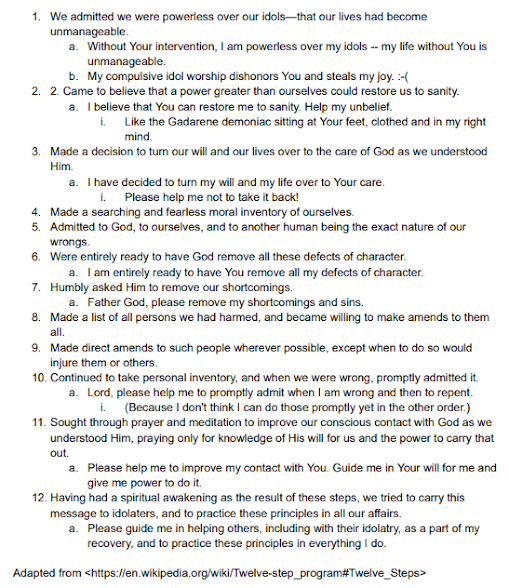
So I personalized the language of AA to idolatry and my general experience. You can see it in the image below (or click through to the Google Doc).

What do you think? Does any of this ring a bell with you? Let me know if you want to discuss it.

Sunday, March 27

New Testament Hymns

This post is an extension of Songs from the Psalms. So here is a list of hymns in the New Testaments and songs I know for them. (I forget where I got the list.) The '+' sign denotes songs I have found to be helpful in practicing a Psalm of the Day.

Lk 1.46-55 (Magnificat)
+ My soul proclaims your greatness, Oh God, Haugen
    Magnificat anima mea Dominum
Lk 1.68-79 (Benedictus)
Lk 2.29-32 (Nunc dimittis)
   Nunc dimittis (Wartburg Choir)
   Now that I've held Him in My Arms, Michael Card
   Lord, now you let your servant go in peace (Lutheran liturgy)
Col 1.15-20
+ Phlp 2.6-11
+ Carmen Christi, Michael Card
   The Exaltation of Christ (Wartburg Choir)
1 Tim 3.16
Eph 5.15 Awake, O sleeper
+ Rev 4.8 Holy, holy, holy, Michael Card
+   We Fall Down, Chris Tomlin
+ Rev 5.9-10 You Are Worthy, Michael Card
+ Rev 12-14 Worthy Is the Lamb, Handel
+ Rev 11.15; 19.6, 16 Hallelujah Chorus, Handel
Rev 11.17-18
+ Rev 15.3-4 Song of Moses, Michael Card
Rev 19.1-8 Hallelujah, Michael Card

Friday, March 25

Recent Preaching and Teaching

I taught Wednesday night Bible Study at our church, Christus Victor Lutheran, for four nights in January and February. The series was called 'The Unbelievable Stories of Jesus' and featured four parables where Jesus exaggerated to make His point. Three of those were recorded. Note: there is some dialogue with the socially-distanced attendees that the mics didn't pick up very well.

Then I preached a sermon entitled 'Why are bad things good and good things bad?' on February 13. Here's a link to the video on YouTube (beginning with the reading of the Gospel): https://youtu.be/a-Chi_ecMA8?t=1321.

Here's a link to manuscript if you'd like to read it: https://drive.google.com/file/d/1YHDrD3xz-83oxHDI4R1xz7GPHa6za78i/view?usp=sharing. There are some notes in the manuscript that did not make it into the sermon.

Monday, September 20

Sermon: Jesus the Winner and His Disciples

I preached in our church, Christus Victor Lutheran, this past Sunday.

Here's a link to the video on YouTube: https://youtu.be/26RVgd5YxDg?t=1789

Here's a link to manuscript if you'd like to read it: https://drive.google.com/file/d/1BWQy_jbwrNzmMPeERix5fk08ZxEZnZfv/view?usp=sharing. There are some notes in the manuscript that did not make it into the sermon.

Sunday, May 16

Report: Two Years of Spending the Day with Jesus


About 13 months ago, I posted after a year of practicing (to some degree) Spending the Day with Jesus as described by Dallas Willard in Life without Lack. This is a post after practicing Spending the Day with Jesus for over two years.

Refer to my previous post if you're interested in my basic approach. It has stayed pretty much the same. It is probably past time to make some intelligent changes.

I have missed some check ins over the last 2+ years, but almost never more than one a day when I'm home (which is almost all the time). I used to travel some for work and sometimes only checked in once at the start of the day.

I think overall this practice has been good. To adapt something Dallas said elsewhere 'You're going to spend two years anyway.' The point was: why not work on developing discipline? I think the discipline of Spending the Day with Jesus especially helped me to get through a tough month of work with some 70-hour weeks and high stress. (Not that I kept up all of my check ins during that time.)

One of my favorite parts of my practice has been adopting a Psalm of the Day. I posted about that previously, too.

Disappointment and Underachievement

I have sometimes thought of calling this section 'Disappointment with Dallas', but it seems a little too sensationalist, and I'm not really disappointed with Dallas, of course. But let me tell you what I mean: Dallas makes unequivocal statements in Life without Lack and elsewhere about what kinds of general results we can expect to get. Here are the main ones from chapter 8 of LwL:

  • 'If you approach the evening in this way, you will awaken with great anticipation of your day with Jesus.' (p200)
  • 'Invite him to be a part of your work and interactions with others. I guarantee that as you do, you and those around you will notice differences of a very positive nature.' (p208)
  • 'I assure you that not many days will pass before you begin to understand the sweetness of walking with Jesus in the sufficiency of the Good Shepherd.' (p211)
  • 'As you practice living your days in the sufficiency of the Good Shepherd, you will make tremendous progress in experiencing the Psalm 23 life that Christ came to provide. You will see remarkable growth and all the good things Jesus desires to give us.' (p213)
I have mostly not seen those results. I've seen small personal results. For one thing, my wife commented on my ability to make it through that hard time at work. I asked my son to review this post and he said he feels like he has seen some growth including more patience including with him.

What do I conclude? First of all, I sure don't think it's been a waste of time.

Second, I suppose I haven't practiced intelligently and intentionally enough. Dallas talks about adjusting our disciplines based on results. I guess I haven't done enough of that. I conclude he was a lot more rigorous in his practice of disciplines, including his concentration. In this time of social media and buzzing phones, I often allow myself to be distracted. My office does not have a door and is adjacent to our entry and main hallway. Not that I plan to go into my bedroom and shut my door immediately. For one thing, it's a shared space with my wife. ;-) But this is something for me to think about some more.

The area I'm currently focusing on for growth (in combination with Spending the Day with Jesus) is a conversational relationship with God as Dallas describes in the Hearing God book and retreat videos on YouTube. I have seen some good results from reading George Muller's abridged journal and letting it inspire my practice. I also re-read Brother Lawrence's Practice of the Presence of God on this topic. I continue to work at learning to pray at 'each change of person or event' (LwL p208).

Wednesday, August 19

Things to Do (from the Psalms)

I created a spreadsheet called Things to Do (from the Psalms).

It started as a list of things the Psalms tell us to do. Then I decided I wanted to be able to sort it in two ways: chapter and verse, but also by first word (which is usually the verb).

There are many phrases that could be added, but these are the ones that stood out to me.

What do you think?

Sunday, April 19

Working in the Easy Yoke for Spending the Day with Jesus

I have been consistently practicing some of Dallas's ideas about spending the day with Jesus (especially when I'm home and not traveling) for about 13 months now. Somewhere in the middle I started to pray through these three verses in Matthew 11 regularly (usually about twice a day). I think the prayers (below) are pretty consistent with Dallas's teaching including the little clip DWM has put up on YouTube. I hope these prayers are helpful for you. :-)

Matthew 11 (ESV)
28 'Come to me, all who labor and are heavy laden, and I will give you rest. 29 Take my yoke upon you, and learn from me, for I am gentle and lowly in heart, and you will find rest for your souls. 30 For my yoke is easy, and my burden is light.'

To pray early in the morning:
'Lord Jesus, I come to You laboring and heavy laden and I lay down my idols. Thank You that You will give me rest. Please help me to take Your yoke upon me and to learn from You. Thank You that You are gentle and humble of heart and I will find rest for my soul. Thank You that Your yoke is easy and Your burden is light.

To pray later in the day (multiple times if desired):
'Lord Jesus, I have come to You laboring and heavy laden and I have laid down my idols. Thank You that You have given me rest. I have taken Your yoke upon me. Please help me to stay in Your yoke and not to leave it to pick my idols back up. Thank You that I have learned from You and that You are gentle and humble of heart and You are willing to teach me as much as I'm willing to do the work to learn. Please help me to get Your vision to learn from You and that it is the greatest privilege in the world. Please help me to set my mind on You and to seek You. Thank You that I have found rest for my soul and please help me to find more rest because there is more for me to find. Thank You that Your yoke is easy and Your burden is light.


And here's a 'meme' my friend, Hugh, made from this post: :-)


Sunday, October 20

Practicing a Psalm of the Day

In this video, Dallas Willard said (notes by Doug Webster):
 
I recommend studying Chapter 15 in William Law, A Serious Call to a Devout and Holy Life - Why we should sing psalms. It’s the connection between the soul (person) and the body. One of the best things ever written on why spiritual disciplines matter. It is the best treatment in the literature.
(I have been praising this video series in the Dallas Willard Facebook group I belong to. It is 17 videos of a class Dallas taught for Denver Seminary in 2010. I used to say the Divine Conspiracy videos were the best thing on the internet, but now I say it's this. Making them even more valuable are Doug Webster's 146 pages of notes.)

I had read all of Law's book before at Dallas's suggestion, but I re-read that chapter after this recommendation.

Then I did some searching on singing the Psalms and just decided to do my own thing based on the fact that I had previously done a project where I listed all of the songs I could that I know that came from the Psalms. I've been 'singing' (sometimes silently) some of them in the morning. Some in that list are not very good for praise, but many are. Then I sort of stumbled into repeating them during my spending the day with Jesus check ins throughout the day. And I've seen some nice instances of the songs sticking in my head or coming back to me during the day.

Saturday, June 15

Congratulations to the Raptors

Since I'm a Jeremy Lin fan, I became a Raptors fan when he got traded there for the playoffs. Unfortunately, he didn't play much, I think because he had some problems with back spasms and Fred VanVleet played out of his mind.

Anyway, I had fun following the Raptors during their run and it's nice to see a team win that hasn't won before. I like Stephen Curry and Steve Kerr, but it's nice to see a change.

A few thoughts:

  • I didn't know Nick Nurse is from Iowa (Carroll) and played at UNI. That's fun.
  • If you stretch it, Steve Kerr also has an Iowa connection: he played for Lute Olson at Arizona.

Saturday, June 8

Abortion Opinions and the State of the Non-debate

From a personal Facebook post.

Poll: Majority Want To Keep Abortion Legal, But They Also Want Restrictions

I've been thinking a lot about abortion. But I won't be sharing my nuanced views here at this time because of the likelihood of being attacked. (That is, I don't think expressing my views would be helpful enough to risk the negative near-certainty of attack.) Culturally we have moved away from the possibility of reasoned debate in public (including online). What 'wins', in the short term, is extremism. But the extremists on both sides are playing a short game that often damages their own long-term interests (which they're willing to do in their sense of self-righteousness).

I'm afraid politico-cultural polarization is a horse that's out of the barn and can't really be stopped at this point. But I do ask you, my friends, to contribute to reasoned debate and not to the shouting match that is not dialogue but just scoring cheap points among like-minded people (and further alienating those on the other side).

After that preamble, the point of this post is to share an extensive article on the results of a poll on abortion opinions. The results show a lot of degrees in US opinion. Then I'm interested in discussing the possibility of dialogue.

Obvious assumption (to me): public consensus does not equal or determine what is right.

A few quotes:

+ Three-quarters of Americans say they want to keep in place the landmark Supreme Court ruling, Roe v. Wade, that made abortion legal in the United States, but a strong majority would like to see restrictions on abortion rights.

+ "The public is very reactive to the arguments being put forth by the more committed advocates on both sides of the issue. The danger for Republicans is that when you look at independents, independents are moving more toward Democrats on this issue. ... When the debate starts overstepping what public opinion believes to be common sense, we've seen independents moving in Democrats' corner."

The most-strongly held opinions (as I read the analysis) are by women who identify as Republican and pro-life or Democrat and pro-choice. It makes sense, of course, that women would feel most strongly about this issue.

What conclusions do you draw about the variety of opinion?

And is there any way for us in the US to find some political common ground here and step back from a polarized culture war with nothing between us but a World War I-style 'no man's land'?

Disrespectful comments will be deleted.

Sunday, April 7

Spending the day with Jesus

If you haven't read Life without Lack by Dallas Willard, Chapter 8 is about spending a day with Jesus. And in it's most basic form, Dallas means 'to take ten minutes or so every two to three hours during the day to lift your heart and mind to God in praise, thanksgiving, and sharing the concerns on your heart.'

I tried this a number of times before it worked for me, at least five. I gave it up for most of a year. But then I had the chance to try it again and something clicked and I'm on a 38-day streak. :-)

I basically just re-read this section of Dallas's book every day and think and pray through it.

My selections from LwL below are somewhat random. If it's not a quotation, it's probably a paraphrase. I share these with you in case they might help you. Otherwise, please mark and make your own guidelines.

Rest in Faith
As you retire to bed, commit to meet with God first thing when you wake, and go over in your mind how that will be. This is a wonderful way to fall asleep in prayer. You can also use the simple prayers of childhood, the Lord’s Prayer, or Psalm 23 to lead you into restful sleep. Whatever you choose, let it include this simple prayer of faith: “I will both lie down in peace, and sleep; for You alone, O Lord, make me dwell in safety” (Ps. 4:8). If you approach the evening in this way, you will awaken with great anticipation of your day with Jesus.
The Day Dawns: Rising with Praise, Petition, and Planning

Praise

'Thank you, God, for this new day. Thank you for this new beginning.'

'Seek seclusion, and if you are able, kneel for five or ten minutes and welcome the presence of Jesus. You may not think it will make any difference to kneel when you pray, but try it anyway. Then consider the difference it may have made.'

Lord God, I give my day to you. Please be with me each moment.

--I have been praying through Mt 11.28-30 here. 'Come to Me, all you who are heavy laden and labor and I will give you rest. Take My yoke upon you and learn from me, for I am gentle and humble of heart and you will find rest for your souls. For my yoke is easy and my burden is light.'

Petition: Casting Your Cares on Him

'Having risen in praise and thankfulness, then you pray for yourself, for the people in your life, and for the things you are facing that day.'

Lord, part of the reason for spending the day with You is to depend on You. Through this practice, I am depending on you. Please help me to depend on You. I need You and I want to see You doing more in my life than I can.

'And the effects of your efforts will be vastly greater than what could result from your abilities alone.' Who Is Your Teacher?

Please remove all fear from my life and fill me with Your love for my life and all that enters it. Please help me to love the life You have given me. Help Your love come through me to everything I deal with today. Help me to carry You through my day in this way.'

'If you have specific concerns, call them out, lay them before the Lord, and submit them to his care.'

'Cast “all your care upon Him, for He cares for you” (1 Peter 5:7).'

Lord Jesus, please give me the faith, death to self, and love that make Your Shepherd’s sufficiency my own.
Remember, these are the marks of Jesus himself. To be with him is to become like him. His life is contagious among those who are susceptible to it, who desire it. Let him know that you want to be infected! Pray, “Lord, make me an instrument of thy peace!” It is truly an expression of the heart of Jesus.
Lord, please help me to become like You by spending my days with You. I want to be infected and infectious.

Planning: When Will I See You Again?

We must plan times through the day to turn our minds to God.

Lord Jesus, I turn my mind back to You.

'I would suggest planning to take ten minutes or so every two to three hours during the day to lift your heart and mind to God in praise, thanksgiving, and sharing the concerns on your heart.'

--I tried coming up with my own hours based on the monastic hours of prayer. But I eventually switched to just having an alarm on my phone labeled 'Spending the day with Jesus', and I just set if for the next good time that's 2-3 hours away. This has worked for me pretty well. Functionally, my times are basically: 7:30, 11:15, 2:30, 5:15, 8:30, 11:15.

--When my schedule is a little bit open and there's a choice between starting the next thing that might run into my next session or just starting the next session early, the latter has worked best for me.

--I typically use Scripture to 'lift my heart and mind to God in praise. Some obvious chapters are Phil 2, Eph 1, Ps 8 and Ps 46. Lately, I have been going through my list of Songs from the Psalms at the rate of one per day and reviewing it multiple times.

Honing Holy Habits

Each session may consists of:
  • Lord Jesus, I turn my mind back to You.
  • Praise and Thanksgiving
  • (Confession earlier in the day instead of just during day-end assessment)
  • Petition and Prayer -- esp. for coming people, events, activities and tasks
  • Planning -- next meeting
--I have been revisiting Mt 11.28-30 here.

I am going to rely on You to realize Your presence with me as the day proceeds. I want you to do more in the lives of my neighbors and me than I can do by myself specifically as I give up what I want and join You in what You want, especially Your 'loving purposes'. I thank You in advance for what will come.

--If you feel like you run out of things to do in these times, you can also try:
  • Going outside and looking at the beauty of a flower or the magnificence of the sky.
  • Listening to beautiful music.
  • Bringing to mind the Lord’s Prayer, an image of the cross, or simply a thought of the Father who is over all.
  • Re-reading the Closing Prayer and the Appendices
  • Reading Scripture
  • Reviewing memorized Scripture (a favorite discipline for Dallas)
  • Re-reading Life without Lack
  • Reading the rest of Andrew Murray's Humility (which Appendix B is one chapter of)
  • Reading The Practice of the Presence of God by Brother Lawrence or The Game with Minutes by Frank Laubach
  • Journaling
The Day Unfolds

Lord, help me to move beyond wanting things to go smoothly to wanting Your will to be done.

I invite You into my situations and interactions. Please accomplish God's loving purposes in them. Thank You.

Psalm 33:13–22 (adapted from the ESV)
13 Lord, You look down from heaven;
    You see all the children of man;
14 from where You sit enthroned You look out
    on all the inhabitants of the earth,
15 You who fashions the hearts of us all
    and observes all our deeds.

     Lord, You know who hopes and trusts in You and who fears You so You can deliver us.

16 The king is not saved by his great army;
    a warrior is not delivered by his great strength.
17 The war horse is a false hope for salvation,
    and by its great might it cannot rescue.

     Lord, we confess that the power of this world will not save us -- politics, force, money.

18 Lord, your eye is on those who fear You,
    on those who hope in Your steadfast love,
19 that You may deliver our souls from death
    and keep us alive in famine.

     'The eyes of the Lord search throughout the whole earth to give strong support to those whose heart is blameless toward Him.' 2 Chr 16.9
     'His eye is on the sparrow and I know he watches me.'
     We hope in Your power to save us and provide for us as our Shepherd.

20 Our soul waits for You, Lord;
    You are our help and our shield.
21 For our heart is glad in You,
    because we trust in Your holy name.
22 Let your steadfast love, O Lord, be upon us,
    even as we hope in You.

'You can consciously will the peace, joy and confidence that you are experiencing to pass from you like 'living waters' to those with whom you are interacting.'

Lord, please help me to learn to pray and bless each time the people, events, tasks and activities in my life change...

'so that mere change becomes a signal to turn your mind back to God. Do this and you will shortly master the secrets of praying without ceasing.'

--I conclude that Dallas did this and mastered it.

Lord, please help me and others to notice very positive differences in me for my encouragement and Your glory.

When I get to take a nap, I generally include thanks at the beginning and then review memorized Scripture verses until I fall asleep and count that as a session. :-)

The Day Concludes . . . with Grace-Drenched Reflection

Lord, please help me to understand and do better tomorrow.

Lord, please help me to become Your vision of me.

'Lord, I need help with this. Please forgive me.'

Thank You for being such a good friend.

'This time of reflection should also include thanksgiving for all the ways the day went well.'

A New Day Begins, and a New Life

Good Shepherd, please help me to better understand the the sweetness of walking with You in Your sufficiency.

'As you practice living your days in the sufficiency of the Good Shepherd, you will make tremendous progress in experiencing the Psalm 23 life that Christ came to provide.'

--Here's a prayer Dallas used to pray for people. I think this version is a little more polished than the version in LwL.

'My prayer for you is that you would have a rich life of joy and power, abundant in supernatural results, with a constant, clear vision of never-ending life in God's world before you, and of the everlasting significance of your work day by day, a radiant life and death'

--Here's a version you can pray for yourself:

Lord, please give me a rich life of joy and power, abundant in supernatural results.
     (Where You do more in and through me than I could do by myself, especially as I join You in Your work.)
Please give me a constant, clear vision of never-ending life in Your world before me,
     (I am an unceasing spiritual being with an eternal destiny in God's great universe.
     And I will not taste death! Please help me to live that way!)
a clear vision of the everlasting significance of my work day by day,
     (Especially to carry Your love to my co-workers and customers.)
a radiant life and death.

Lord, please fill me with the knowledge of Your will in all wisdom and spiritual understanding;
please help me to live/walk worthy of You, fully pleasing You, being fruitful in every good work and increasing in the knowledge of You;
please strengthen me with all might, according to Your glorious power, for all patience and longsuffering with joy;
I thank You, Father, that You have qualified us to be partakers of the inheritance of the saints in the
light. (Col. 1:9–12 adapted.) Thank You that You have adopted us to be Your heirs.
     This inheritance starts now and is such Good News that it's unbelievable except that You have said it. We thank You and praise You!

My (not Dallas's) final thoughts

Something I wondered about: does Dallas differentiate between addressing God and addressing Jesus and spending the day with Them? I haven't detected any noticeable difference in his usage.

A big part of the positive result for me of spending the day with Jesus is simply a higher baseline of well being including peace, joy and confidence. For example, I still fell defensive, but not as much. If someone says something that I might feel defensive about, I can shake it off more easily. My baseline level of anxiety has gone down.

If you made it this far, you might be interested in my adaptation of Psalm 23 in iambic octameter: My Shepherd, an adaptation of Psalm 23. You might also be interested in my version of Psalm 16 with specific comments on God's presence and spending the day with Jesus: Psalm 16 for Spending the day with Jesus.

Saturday, April 6

Psalm 16 for Spending the day with Jesus

Lately, I have been focusing on spending the day with Jesus as discussed in Dallas Willard's Life without Lack. Since spending the day with Jesus is to a great degree about being in His presence, in the tradition of Brother Lawrence (Practicing the Presence of God) and Frank Laubach (The Game with Minutes), here are some notes on Psalm 16 with a focus on God's presence. (For additional notes on Psalm 16, see my earlier post Praying Psalm 16 (and a couple of other notes).)

Preserve me, O God, for in you I take refuge
-'in You', that is 'Your presence'

I confess that You are the Lord. I have no good apart from you.
-apart from Your presence

Please help me to delight in the saints.

I confess that my sorrows multiply when I run after other gods. Please help me not to pour out their drink offerings of blood or take their names on my lips

Lord, I have chosen the portion that you have chosen for me.

The lines have fallen for me in pleasant places; indeed I have a beautiful inheritance.
-especially in You and Your Kingdom
(To what extent is 'the Kingdom' Your presence?
'The Kingdom of Heaven is at hand.'
In other words: 'I am here.'

Bless You, Lord. Thank you that You counsel me and my heart instructs me at night.
-I think there's presence here, too (but it could be a stretch ;-) )

I have set the Lord always before me; when You are at my right hand, I shall not be shaken.
-Now this is about presence! Setting the Lord before me and Him at my right hand are being in His presence.

Therefore my heart is glad and my whole being rejoices, my flesh also dwells secure.
-My heart is glad and my whole being rejoices in God's presence.
(In the OT especially, the normal experience of salvation includes physical safety, though it is not universal.
In the same way, the normal experience of salvation in the NT brings persecutions for Christ's sake.)

Thank You that You will not abandon my soul to Sheol, or let your holy one see corruption.

God, You make known to me the Path of life, which is Jesus and is in Jesus.
-Jesus said He is the Way. And part of that is His presence, walking with Him, following Him.

In Your presence there is fullness of joy; at your right hand are pleasures forevermore.
-Your presence, Lord, is when I put You at my right hand and You put me at Your right hand and I stay (remain) there.

Wednesday, March 27

My Shepherd, an adaptation of Psalm 23

Because You are my Shepherd, Lord
I don't lack any thing I need.
You settle me in lush, green grass.
You lead me by clear, quiet pools.
You bring me back for Your name's sake
to guide me by Your holy paths.

Although I walk beneath the walls
of death's dark threat, I will not fear
because Your presence keeps me calm.
I trust Your rod and staff to guard.

You feed me in a hostile land
anointing oil pour on my head.
Your blessings overflow my cup.

Your goodness and Your mercy sure
will follow me for all my life.
And I'll return to live always
within Your house forever, Lord.


Notes

  1. I planned on this adaptation being iambic pentameter, but it fell into iambic octameter.
  2. This adaptation includes ideas from Kenneth Bailey's The Shepherd Psalm. On this subject I have also read Phillip Keller's A Shepherd Looks at the Twenty-third Psalm and Tim Laniak's Shepherds After My Own Heart. Some ideas come from my own attempts to make the best sense of this ancient prayer.
  3. What was third person has been changed into second, not least for purposes of prayer.
  4. I have some reservations about line 11 begin only one line and not two.
  5. I tried to keep my wording close to normal speech (v. poetic diction). Therefore a lot of lines start with 'You' or 'Your'.

Sunday, February 3

Praying Psalm 16 (and a couple of other notes)

Note: some of this departs from strict exegesis and begins to become subjective application.


Preserve me, O God, for in you I take refuge.
-especially from the world, my flesh and the devil.

I confess that You are the Lord. I have no good apart from you.
-I'm sorry for the times I look for good other places.

Please help me to delight in the saints.
(And, therefore, to be influenced by them in contrast to the idolaters we read about in the next verse.)

I confess that my sorrows multiply when I run after other gods. Please help me not to pour out their drink offerings of blood or take their names on my lips
-especially with the idolatrous sins that have become unconsciously habitual in the last 47 years.

Lord, I have chosen the portion that you have chosen for me.
-Please help me to actively, repeatedly choose it.

The lines have fallen for me in pleasant places; indeed I have a beautiful inheritance
-especially in Jesus and His Kingdom and specifically in Christine, Elizabeth and Wil.

Bless You, Lord. Thank you that You counsel me and my heart instructs me at night.

I have set the Lord always before me; when You are at my right hand, I shall not be shaken.
-Please help me to set You before me.

Therefore my heart is glad and my whole being rejoices, my flesh also dwells secure.
-Please help me to be glad and rejoice.

Thank You that You will not abandon my soul to Sheol, or let your holy one see corruption.
('Holy one' was for David, the King, and especially for Jesus, but I am holy now in Jesus and can live forever in Him.)

God, You make known to me the Path of life, which is Jesus and is in Jesus.
(He said 'I am the Way' in John.)

In Your presence there is fullness of joy; at your right hand are pleasures forevermore.
-Please help me to experience your joy and the eternal pleasures of Your presence.


Just a little recap of the benefits of choosing God ('a beautiful inheritance') in this psalm:
  • My heart is glad
  • My whole being rejoices
  • In your presence there is fullness of joy
  • At your right hand are pleasures forevermore

Remember that old bumper sticker 'God is my copilot'? Then there was a counter-bumper sticker that said something like 'If God is your copilot, switch seats.' That's a false dichotomy according to this psalm. We all have decisions to make and actions to take that only we can. We all have a 'right hand' where something or someone has to sit. There is a valid point to be made in saying God should be our Pilot or 'let go and let God', but it will never change the fact that we are ultimately responsible for our choices and we have to keep making them, even if we want to be guided or led by God.

Saturday, December 22

Can you argue convincingly that the Trump presidency is not a disaster?

Can you argue convincingly that the Trump presidency is not a disaster? What presuppositions do you have to make to do that?

(All civil comments accepted. I will tell you in advance that I'm not going to be very convinced by 'he's better than HRC would have been', but I'm willing to listen to specifics.)

This post began with this article from FactCheck.org [https://www.factcheck.org/2018/12/the-whoppers-of-2018/] which includes Trump's top 10 lies of the year. The President regularly lies on the public, global record.

That article also includes reference to two of Trump's extramarital affairs. His comments about sexual assault and the women who have accused him of it should also be considered here.

The Republican Party once claimed to be the party of family values and morality. Is there not even any pretense to that any more? Is it so much more important to back a 'winner'? If Obama had done these things, the Republicans would have gone berserk.

I believe many conservative Christians voted against HRC when they voted for Trump, and especially on the moral issue of abortion. Is your argument here that, even though he's a morally bankrupt narcissist, we have to compromise on that because of the 'wider effect' of abortion policy?

While all of my friends are moral, some may argue for a Kissinger-esque realpolitik. Apart from Trump's moral bankruptcy, here's a non-exhaustive list of recent non-moral issues:

  • Government shutdown in part over paying for a wall between us and Mexico (though I'm open to immigration reform)
  • The market crash, including trade policy
  • Foreign policy most characterized by making friends with dictatorships like Russia, China, North Korea, Syria and Turkey
    • Continuing to pursue friendship with Putin in the face of our own intelligence community which is unanimous that Russia messed with our election
  • SECDEF Mattis's resignation, the last appointee in the Trump administration with any bi-partisan support that I can think of (open to being reminded)
  • Indifference to the rule of law as exemplified by past SECSTATE Tillerson's recent quote: 'So often, the president would say, ‘Here’s what I want to do, and here’s how I want to do it, and I would have to say to him, ‘Mr. President, I understand what you want to do, but you can’t do it that way. It violates the law.’'

What do you think (with special interest in civil comments from conservatives)?

Monday, December 17

'C.S. Lewis: A Life' by Alister McGrath -- Short Review and Longer Reflections

This is a good book that is worth reading if you're interested in Lewis. McGrath is a researcher. He read all of the primary sources to write this book, including some (like letters) that had not been available previously. Therefore, he has complete command of the available facts. He even produces a new timeline of Lewis's conversion that is convincing. (The most interesting part is that, if McGrath is right, Lewis misreported an important date.) All of this factuality is strong. It means that McGrath has paragraphs or sections that sometimes plod a little, but these passages are rare and short and easily overlooked.

A few of my reflections:

The first thing that jumped out at me, as addressed by McGrath, is Lewis's motivation by and usage of imagination. He often presents as being supremely rational. That is the first thing that some people would mention about him, considering landmarks like The Problem of Pain or Mere Christianity.

However, even more than being very rational, Lewis was driven by imagination and prodigiously engages the imagination of his readers. McGrath does a good job of describing how Lewis himself was motivated by imagination as a path to understanding and inspired the same thing for his readers. Before he could ever have been regarded as a paragon of reason, Lewis understood and, indeed, lived in the world through imagination. Before he became an academic, he wanted to be a poet. Imagination is the path to reason that he primarily offers to his readers. In fact, he often goes above or beyond reason to address things that it cannot.

This brings up an interesting observation. Lewis burst onto the popular scene as a seeming apologist. But, as Austin Farrer says (p222), what he was really giving to BBC listeners during World War 2 was a vision of Christianity that they could consider and that obviously attracted many. He was subject to criticism from philosophers and theologians that his arguments were not thoroughgoing enough or were too shallow. This was true, in a way, because he was never well placed (or trained) for serious philosophical apologetics. Nor did he intend to engage at that level. He was a popular apologist who cast a vision. He found apologetics exhausting and never really accepted or met its philosophical standards. Before long, he gave it up.

Lewis had some very strange relationships with women, to put it mildly. his relationships with Mrs Moore and Joy Davidman seem odd given his public persona and they should be included in any overall assessment of Lewis's life (which McGrath does).

As someone who was first a fan of JRR Tolkien, the dissolution of their friendship is sad to me. My most recent other source on their lives was 'The Fellowship: the Literary Lives of the Inklings'. My reading of that book lowered my opinion of Tolkien and raised my opinion of Lewis, However, reading McGrath's book 'corrects' those estimations a little. Tolkien drew back from Lewis when Lewis's friendship with Charles Williams grew, to some degree because of self-doubt. But Tolkien worked with perseverance to get Lewis his position at Cambridge, breaking through Lewis's own misunderstanding. In the same way, Lewis nominated Tolkien when they were fairly estranged for the Nobel Prize.

Perhaps because of this distance, and also because of the extreme irregularity of the relationship, Lewis included almost none of his friends in his relationship with Joy Davidman. But, as Lewis himself often argued in general, we should reserve some of our judgment regarding people from a bygone era. Lewis's friends, including Tolkien, had a different view of divorce and remarriage than we do. It's easy to look back and condemn them in this regard, but we should hold back, at least a little. By any measure, the relationship was always strange, certainly not the fraughtless romance of the 1993 movie 'Shadowlands'. Apart from the breaking of multiple conventions, Lewis's friends, including Tolkien, were undoubtedly concerned that Davidman might be using him. His brother, Warnie, certainly regarded the situation that way.

McGrath, an Evangelical himself, does a good job of addressing how Evangelical's have considered Lewis, up to this day when he can, in a sense, be regarded as their (our) 'patron saint'. For my part, I want to draw two brief connections. One weak part of Lewis's Mere Christianity is the individualness of it (i.e. it mostly leaves out the critically communal part of the faith). I suspect this has appealed to Evangelicals as it is a weakness they (we) have also been prone to.

Also consider The Problem of Pain, Lewis's first popular work. Although it is intellectually sound as far as it goes, The Problem of Pain is fairly shallow in basically not treating the emotional complexities of faith and suffering. It should be compared with A Grief Observed to think through the changes in Lewis's life and how a merely intellectual treatment of pain is inadequate. I think The Problem of Pain comes from a time in Lewis's life when he had locked out his own significant earlier suffering including the loss of his mother at a young age, his father's terrible inadequacy afterwards, and the horrors of the trenches of World War 1.

One final example of brokenness in Lewis's life was his anxiety about money. He often struggled with it and, even when he was comparatively wealthy, he was so worried about being able to afford retroactive taxes (which had been charged to him before), that he was incapable of being generous. Although Lewis's writing inspires us to hope for substantial healing in this life for ourselves, his own life is a little disappointing in this regard. I feel sorry about his own experience and wish he had experienced more growth as an encouragement to my own hope.